

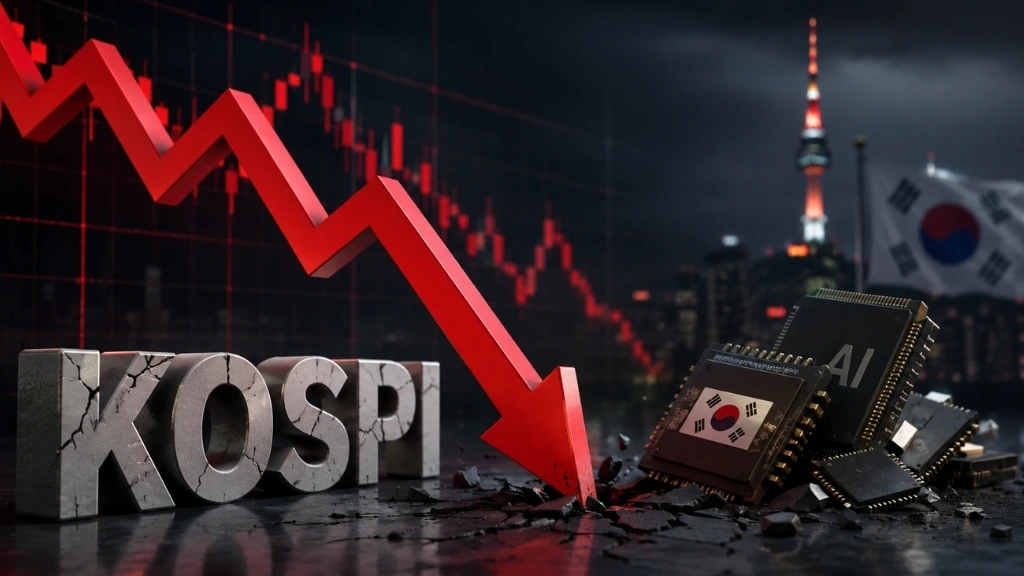
Korean stocks suffered a brutal session on Monday, July 20, 2026. The current situation has pushed KOSPI well into bear market territory and has wiped out trillions in value as investor confidence in the AI-driven chip boom suddenly crumbled.
The index slid as much as 4.5% in the first trading day after the Constitution Day holiday, bringing the KOSPI to more than 30% below its June peak (the standard threshold for a bear market). The losses were huge, but the biggest names drove much of the pain. Samsung Electronics tumbled about 4.3% and SK Hynix dropped 4.2%. Together, these two chip giants make up roughly 60% of the KOSPI’s market capitalization, so their declines hit the index especially hard.
What Changed So Fast?
Market chatter points to renewed doubts about how much firms will spend on AI infrastructure. Moonshot AI’s new Kimi K3 model has reignited conversations about the place and cost of AI rollout, reviving memories of the “DeepSeek” shock that rattled markets in early 2025. When the AI growth story looks shakier, investors pull back from the very stocks that had been the biggest beneficiaries.
Leveraged ETF Fallout
The pain has been amplified by leveraged products. Since the end of May 2026, Korean retail investors have poured about 14 trillion won ($9.4 billion) into single-stock leveraged ETFs that bet heavily on chip names. These funds have seen dramatic reversals. The largest Korea-listed 2x long ETF focused on SK Hynix is down about 70% from its June high and roughly 50% since it launched. This kind of rapid unwinding can accelerate falls, because leveraged positions force big, rapid trades when prices move against them.
Even SK Hynix’s U.S.-listed shares have felt the pressure, trading around 10% below their July 10 opening levels. The concentration of margin, ETFs and retail money in a few names created crowded positioning (a setup that can magnify moves when sentiment shifts).
Big Hits Across Industries
This is not just a tech story. The carnage has spread across autos, shipbuilding and industrials, turning what looked like a sector wobble into a marketwide retreat. Over the past month the KOSPI reportedly plunged roughly 23% in July alone, erasing about 1,590 trillion won (roughly $1 trillion won) in market value.
Individual large-cap moves were stark: Samsung Electronics down about 34.5%, SK Hynix down 35.3% and Samsung Electro-Mechanics falling more than 44%.These are broad, deep cuts across multiple industries in a very short span.
What Analysts are Saying
Institutional flows highlight the mixed picture. Monday’s trading showed heavy institutional selling (institutional net-sold about 920 billion KRW), while individual and foreign investors were net buyers, adding roughly 350 billion KRW and 510 billion KRW respectively. Heads of 18 securities research centres unanimously signaled that the recent pullback does not necessarily mark the start of a sustained decline. Several firms, including Daishin, Samsung and Hana Securities, suggested a rebound could come later this month.
Citigroup’s Mixed Message
This cautious posture is echoed by big banks. Citigroup recently moved its tactical rating on South Korea from overweight to neutral while still assigning a long-term KOSPI target that implies roughly 47% upside from current levels. The dual signal can be confusing. It does not mean Korea’s fundamentals are broken, only that the short-term trading backdrop is riskier.
Final Thoughts
Korea’s chip-led boom has run into a reality check, and the fallout is being amplified by concentrated retail flows and leveraged products. Whether the market stabilizes or falls further will depend on how fast AI spending expectations adjust and whether buyers return to soak up the forced selling. For now, investors face a bumpy road, big upside remains on paper, but getting there may mean more dramatic swings than many want to ride.