

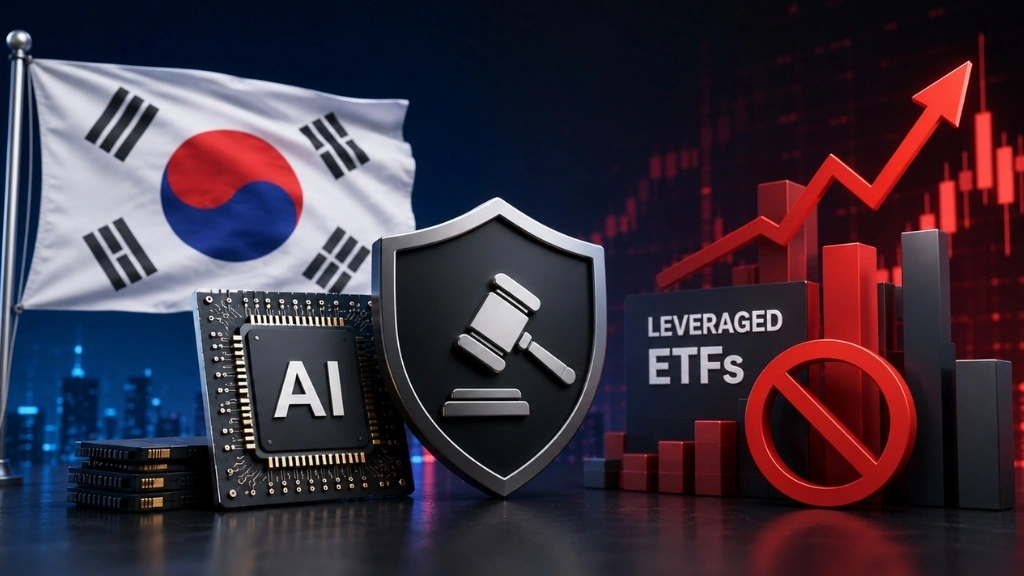
South Korea’s financial regulator, the Financial Services Commission (FSC) has introduced new rules aiming to bring down the market swings that are mainly caused by single-stock, leveraged exchange-traded funds (ETFs) that focus on major chipmakers.
Single-stock, leveraged ETFs tied to chip giants such as Samsung Electronics and SK Hynix were launched in late May 2026. These funds use derivatives to increase returns, and regulators say they have contributed to sharper price moves in the market.
In one of the statements, the regulator stated, “Recently, various worries and the need for improvements have been raised about further increases in already heightened volatility in major memory chipmaker stocks globally and a high possibility of increasing investor losses”.
Key Changes to Investor Rules:
The FSC announced several measures designed to limit retail investors’ exposure and reduce speculative trading:
- Higher minimum deposit: Retail investors must now place a minimum of 30 million won (about $20,300) to invest in these ETFs, up from 10 million won.
- Bigger trading units: The minimum trading unit rises from one share to 20 shares, making small, frequent trades harder.
- Mandatory risk education: Retail buyers will have to complete additional courses on the risks of leveraged products.
- Guidance to brokerages: Firms will be advised against launching new leveraged ETFs and running promotional events that could encourage risky purchases.
According to the officials, the moves that are being adopted strike a balance between safeguarding investors and market efficiency. The officials also pledged that if the volatility remains high, then they will even consider further steps. These measures come after consultations by the key economic policymakers, which also include the finance minister and central bank governor.
How Single-Stock Leveraged ETFs Can Increase Volatility
Single-stock leveraged ETFs aim to deliver a multiple of a single company’s daily return by using derivatives and borrowings. This means that the gains can be huge, but losses could be magnified equally. As these funds concentrate on one stock, heavy buying or selling of the ETF can push the underlying share price more than broader funds would.
Regulatory concerns are heightened for memory chipmakers because their shares can move quickly in response to industry cycles and news. Amplified bets through leveraged ETFs can create feedback loops, where ETF trading influences the stock, which in turn affects ETF prices.
Daily Rebalancing and Long-Term Risk
An important point for everyday investors is that leveraged ETFs typically rebalance daily to maintain their target leverage. Over multiple trading days, this rebalancing can lead to returns that diverge from the stock’s long-term performance, especially in volatile markets. This makes these ETFs generally unsuitable for buy-and-hold investors.
Market and Industry Reaction
Market participants are likely to reassess strategies that depend on concentrated leveraged positions. Brokerages may delay new product launches and scale back marketing aimed at retail clients.
For retail investors, the changes raise the bar for participation. Higher deposit and trading unit requirements, plus mandatory education, are intended to prevent impulsive trades that can lead to large losses. Investors who lack the required capital or who do not complete the risk courses will face limited access to these specific ETFs.
Future Outlook
The FSC said it will monitor conditions and may implement further measures if needed so that the markets can be stabilized. Traders should study how the brokerages respond and whether trading patterns in chip stocks calm down or not.
All in all, South Korea’s regulatory body FSC is making an effort to protect traders from the potential harm from single-stock, leveraged ETFs that are tied to major chipmakers. By adopting the above-mentioned rules and regulations (tightening capital requirements, increasing trading sizes, reinforcing investor education, and advising brokerages to refrain from aggressive promotion) authorities aim to reduce speculative pressure and protect retail investors.