
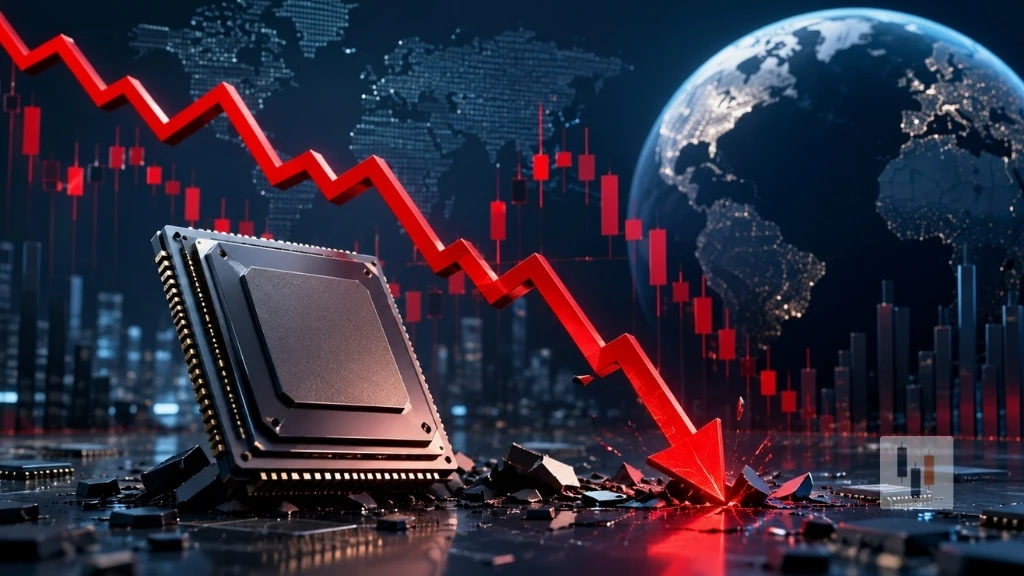
The worldwide AI trade hit another low tide on Tuesday, July 28,2026, as semiconductor stocks across Asia followed Wall Street. This also raised concerns amongst stakeholders over artificial intelligence infrastructure spending, China’s surging semiconductor vision and a week full of monetary policy.
Japan’s Nikkei 225 fell 3.95%, while South Korea’s Kospi plunged 10.84%, leading to a market-wide circuit breaker after dropping more than 11% during intraday trading. The stern selloff expanded an overnight fall in the U.S. chip stocks, where Nvidia, Micron and SanDisk all witnessed steep losses.
Although AI remains one of the strongest long-standing investment themes, the newest correction shows that stakeholders have become sensitive to assessment funding and macroeconomic risks.
Global Chip Selloff Spreads Across Markets
The sell-off began on Wall Street before moving towards Asian stocks. Nvidia (NVDA) plunged 4.9%, Micron (MU) fell nearly 5%, while SanDisk (SNDK) declined more than 10% as stakeholders took profits in semiconductor stocks that have surged over the past year. The issue quickly spread to Asia, where chip makers bore the loss. Japan semiconductor heavy stocks were among the first to be affected, with Kioxia (285A.T) plunging 18.3%, Advantest (TSE:6857) tumbling more than 10%, and Tokyo Electron (8035:TYO) falling around 11%.
South Korea’s technology sector also faced a similar tumble, as SK Hynix (000660:KRX) fell more than 14%, while Samsung Electronics (005930:KRX) plunged over 13%, dragging the Kospi sharply lower. Taiwan’s TAIEX also fell as semiconductor shares fell across the region. The comprehensive nature of the fall suggests stakeholders were decreasing exposure to the semiconductor niche rather than acting to company-centric developments.
The Forces Behind the Market Selloff
Several major causes are merging at the same time. One reason is renewed attention on China’s semiconductor development after reports say that native companies are moving towards native chip-making equipment. But China still faces constraints on advanced semiconductor technologies. Perennial progress has reinforced stakeholder concerns about long-standing competitive environments for global chip suppliers.
Markets are also digesting reports surrounding Nvidia’s discussion to help push for large data center projects. The alleged financing arrangements have garnered debate about how AI infrastructure expansion will be funded as capital requirements continue to rise. Stakeholders are increasingly questioning whether AI companies, cloud providers, and chip makers can balance the unprecedented pace of infrastructure funding over the upcoming years.
Similarly, attention also moved towards macroeconomic risks. The U.S. Federal Reserve begins its newest policy meeting this week (Wednesday July 29, 2026), with stakeholders closely focusing on any signals on future interest rates. More borrowing costs could weigh on technology assessment, particularly for organizations whose development depends on long-term AI investments.
Adding to the ambiguity, Microsoft, Meta, Apple, and Amazon are planning to report earnings within days of one another. Their outcomes and capital spending guidance are expected to provide one of the clearest indicators yet of whether AI spending remains as volatile as markets expect.
Markets Brace for a High-Stakes Week
The current withdrawal comes at a crucial moment for the AI sector. Chip stocks have driven much of the market gains over the past two years, supplemented by massive spending on AI infrastructure. But with semiconductor assessment near historic highs, stakeholders are asking for evidence that future earnings can withstand continued investment. Bitcoin’s drop below $63,000 also showed the broader risk-off mood as traders reduced exposure to user set ahead of major economic and enterprise announcements.
Whether this week’s fall proves to be a temporary correction or develops into a bigger pullback may depend on three watched events: the Federal Reserve’s policy decision, revenue and AI spending commentary from the largest technology companies, and stakeholder confidence that the AI infrastructure boom can work without creating funding pressures. For now, markets are treating the AI trades with awareness that they have for much of the past year as macroeconomic ambiguity clashes with questions about the next phase of semiconductor demand.