


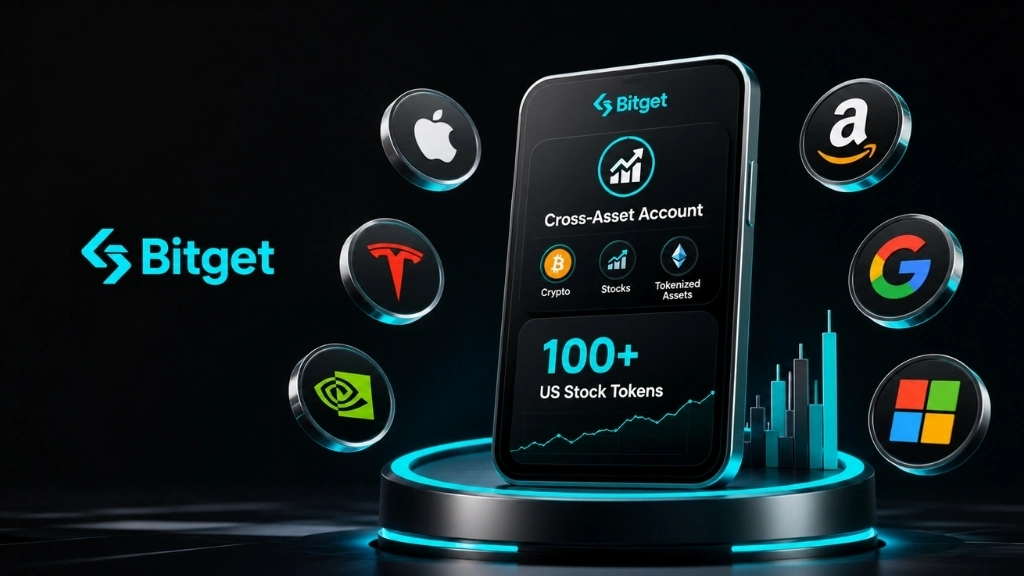
- Bitget introduced its Cross-Asset Unified Account, which combines more than 370 assets in a single unified margin resource, comprising approximately 100 tokenized US equity rTokens.
- Equity tokens can now be used to trade futures and margin equity positions while retaining the equity exposure and dividend rights of the underlying tokens if applicable.
- The initially supported rTokens are major U.S. companies and indices, including Apple, Tesla, Nvidia, Microsoft, the S&P 500, and the Nasdaq-100.
Bitget has launched a new unified account system, which brings cryptocurrencies and tokenized US stocks under one margin resource. Over 370 assets are included in this setup, including approximately 100 equity tokens, and it represents an attempt to apply the same operational rules for trading and borrowing to traditional market holdings and digital currencies.
Cross-Asset Integration in Practice
The account structure enables the stock owners holding these tokenized securities to retain their investments while also using the same holdings to collateralize futures, margin trading, and lending in the stablecoin asset class. Dividend payments on underlying companies remain as applicable so that users can earn income without liquidating positions or moving assets between wallets or sub-accounts. The tokenized equity gets a collateral valuation discount that can be up to 95%, depending on the specific equity and the number of tokens held. Interest rates on any loans vary hourly according to the market conditions of supply and demand.
The idea behind this is to merge the previously disparate categories of assets into one capital structure. Investors can now keep the exposure they gained in digital assets and equity markets without having to move their assets back and forth between these different markets. The mechanism allows for multiple concurrent uses of the same asset, e.g., holding it for value appreciation while applying its value to make leveraged trades in the rest of the account.
Stages in Account Architecture Development
Digital exchanges have gone through various stages of account structure evolution. The early setups had to allocate margins for each trading position or asset class, leading to an inefficient use of capital allocation in many cases. A later strategy of the company was to mix together different cryptocurrencies into a single pool and allow for a single set of funds to back several positions at the same time. The latest development takes this thinking to the asset class, including not just digital currencies but tokenized shares of big US-listed companies.
The system minimizes repeat transfers or multiple sub-accounts, decreasing idle resources and simplifying risk management processes.
“Bringing stocks on chain is the first step, but the real breakthrough comes when those assets can work with the same flexibility as crypto,” said Gracy Chen, CEO of Bitget. “Capital efficiency is one of the principles behind UEX, and the Cross-Asset UTA puts that idea into practice. A stock position should be able to hold value, support another trade, or unlock liquidity instead of sitting in isolation.”
Supported Assets and Operational Details
The first set of supported tokens includes shares in companies like Apple, Amazon, Meta, Tesla, Google, Nvidia, Microsoft, JPMorgan Chase, Walmart, Visa and more, as well as larger market indexes such as the Nasdaq-100 and S&P 500. They serve as rTokens generated under an affiliated protocol to provide exposure to the price action of a related equity with complete trading in the exchange environment.
Eligible collateral follows defined tiers based on asset characteristics and position sizes. It is a dynamic system that continually processes borrowing rates, updating them hourly to reflect current conditions. It is applicable to all eligible assets in the pool (more than 370) and forms a single resource for cryptocurrencies and tokenized equity transactions.
Building on Tokenized Equity Achievements
Bitget highlights that its tokenized equity offerings, managed by the Reality protocol, had surpassed $100 million in managed assets and $671 million in total trading volume within a month of launch. The new unified account is built on this foundation by introducing new practical uses of these tokens to enable them to support hybrid portfolios with a mix of long-term token ownership and short-term trading/leverage activities.
Future plans indicate that additional instruments will continue to be part of the system as conditions and operations continue to evolve in the market.