
Key Takeaways
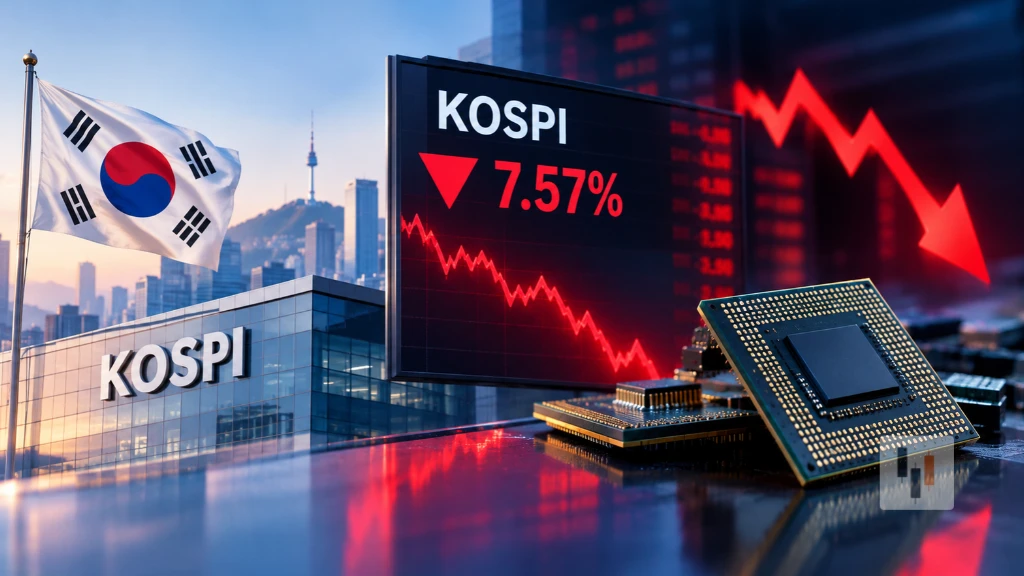
- South Korea’s KOSPI fell 7.57% on October 15, extending its losing streak to seven consecutive sessions.
- Samsung Electronics and SK Hynix declined as investors reassessed AI-related investment and semiconductor market risks.
- Concerns about memory-chip oversupply around 2029 have added another uncertainty to the sector’s outlook.
- Current demand for advanced AI memory and future production growth could create different supply conditions across chip categories.
South Korea’s benchmark KOSPI index fell 7.57% on October 15, closing at 5,554.22 as semiconductor stocks led a broader market sell-off. Samsung Electronics dropped 9.48%, while SK Hynix lost 11.06%, extending pressure on two companies that play a central role in the country’s stock market and global memory-chip supply.
The decline came amid renewed concerns about the sustainability of artificial intelligence (AI) investment, higher US inflation and the possibility of further interest rate increases. The market downturn has also drawn attention to a longer-term question facing memory manufacturers: whether new production capacity could eventually outpace demand. A potential oversupply around 2029 has been discussed in South Korean business commentary, although that possibility remains a forecast rather than an established outcome.
KOSPI Falls As Samsung And SK Hynix Lead Semiconductor Sell-Off
The KOSPI closed at 5,554.22 on October 15, its lowest closing level since April 7, after falling as much as 9.29% during the session. The decline prompted a marketwide trading halt, while the exchange also activated a mechanism that temporarily suspended program selling as losses intensified; the index’s seven-session losing streak was its longest since September 2024. Semiconductor shares accounted for much of the pressure. Samsung Electronics fell 9.48% to 210,000 won, while SK Hynix declined 11.06% to approximately 1.26 million won. Foreign investors were net sellers of South Korean equities, offloading shares worth 3.62 trillion won, according to Yonhap.
The broader backdrop included higher-than-expected US inflation and renewed uncertainty over interest rates. Investors have been reassessing whether the spending on AI infrastructure will generate sufficient returns to support current market valuations. Higher borrowing costs can also weigh on technology companies whose valuations depend partly on expectations of future growth. The decline was not limited to memory manufacturers. Yonhap reported that IT hardware and power-equipment stocks also fell as sentiment weakened across businesses associated with AI infrastructure. This suggests that the market pressure extended beyond concerns about individual companies.
Discussion on Reddit’s SK Hynix community also reflected uncertainty among retail market participants as the sell-off continued. However, social media reactions provide a snapshot of investor sentiment, not evidence of the underlying causes or a reliable indication of where prices will move next.
Memory Oversupply Concerns Complicate The AI Chip Outlook
The market decline has coincided with a separate debate about the memory industry’s longer-term supply outlook. In a post published on October 15, investor Melvin said a column in South Korea’s Maeil Business Newspaper had raised concerns that additional manufacturing capacity could lead to global memory oversupply beginning in 2029. The concern centres on the possibility that manufacturers will bring more production capacity online over the next several years. If supply grows faster than demand, memory prices and profit margins could come under pressure. That would matter for South Korea, where Samsung Electronics and SK Hynix are major players in the global semiconductor industry.
As Melvin noted in his X post, building semiconductor facilities takes years, and newly installed capacity does not immediately translate into fully operational production. Equipment installation, manufacturing yields and customer qualification can all affect when additional supply reaches the market. The distinction between memory products also matters. High-bandwidth memory (HBM), used in advanced AI computing systems, has different production requirements from conventional DRAM and NAND memory. An increase in overall manufacturing capacity would not necessarily mean that every type of memory becomes available in sufficient quantities at the same time.
Reporting by the Korea JoongAng Daily in March described how manufacturers were expanding facilities while shortages of advanced memory remained a concern, with much of the investment directed toward infrastructure and advanced packaging. Its report on memory production and supply constraints illustrates why additional investment does not immediately eliminate supply constraints.
For investors, the central question is whether demand for AI-related memory will continue to grow quickly enough to absorb new capacity. The current sell-off reflects uncertainty about AI spending, valuations and future returns, while the 2029 oversupply discussion concerns a possible change in supply and demand further ahead. Neither issue alone establishes that the memory cycle has peaked.