Key Takeaways
- South Korea’s KOSPI closed 5.28% lower as semiconductor shares came under pressure.
- Samsung Electronics fell 7.57%, while SK Hynix shares declined 9.46% on Thursday.
- Concerns over tighter US rules for AI data centers added pressure after the midterm elections.
- Foreign investors sold more than 3.4 trillion won in shares listed on the KOSPI.
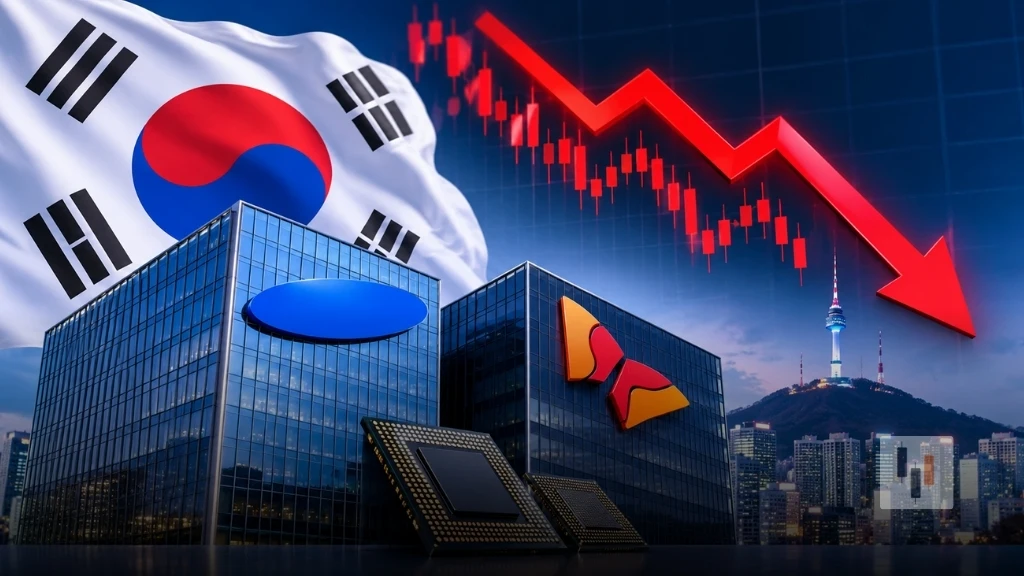
South Korean stocks ended Thursday’s session sharply lower, with losses in Samsung Electronics and SK Hynix weighing on the wider market. The KOSPI fell 300 points, or 5.28%, to close at 5,383.80, after selling pressure increased throughout the trading day. The decline followed the US midterm elections, which raised concerns among investors that a Democratic-controlled Congress could introduce tighter oversight of artificial intelligence infrastructure and data center development. Semiconductor companies were among the most affected, as investors considered what additional restrictions could mean for future spending on AI systems. Foreign investors also sold a significant amount of South Korean equities during the session, adding to the pressure on the benchmark index.
Samsung And SK Hynix Shares Fall As Foreign Investors Sell South Korean Stocks
Samsung Electronics and SK Hynix were among the main contributors to Thursday’s decline. Samsung shares dropped 7.57% to close at 201,500 won, while SK Hynix fell 9.46% to 1.26 million won. Both companies supply memory chips used in servers and other computing systems, including infrastructure supporting AI applications. Their size and influence within South Korea’s stock market also meant that their losses had a considerable effect on the KOSPI.
The benchmark index opened at 5,580.09, down 1.82% from its previous close, before extending its losses during the morning. At one point, it fell to 5,336.88. The Korea Exchange activated a sell-side sidecar at 10:16 a.m., temporarily suspending program selling orders for five minutes. The measure is used when futures prices fall sharply and is intended to give the market a brief period to absorb selling pressure. Foreign investors recorded net sales of approximately 3.42 trillion won in KOSPI-listed shares. Individual investors bought around 2.27 trillion won, while institutional investors recorded net purchases of approximately 844 billion won. The losses also spread to other companies in the sector. Hanmi Semiconductor fell 9.13%, while Samsung Electro-Mechanics dropped 15.34%. The KOSDAQ also ended the day down 5.11% at 678.41.
Earlier in the session, Coin Bureau reported that Samsung and SK Hynix had lost more than $100 billion in combined market value within the first hour of trading. The KOSPI was down around 3.5% at the time, with SK Hynix falling 7.4% and Samsung losing 5.3%. Both stocks fell further before the market closed. The decline came as investors weighed the possible impact of the US midterm election results on AI policy.
🇰🇷 NOW: Over $100,000,000,000 wiped from Samsung and SK Hynix within the FIRST HOUR of trading.
South Korea’s KOSPI falls 3.5% as chip stocks lead the selloff, while Japan and Australia trade higher.
SK Hynix is down 7.4% and Samsung is down 5.3%. https://t.co/9Sr0irbOVb
— Coin Bureau (@coinbureau) November 5, 2026
US Election Results Raise Questions Over Future AI Spending
Samsung and SK Hynix have both seen demand for their memory chips grow as companies build more AI infrastructure. SK Hynix supplies high-bandwidth memory used in AI processors, while Samsung also makes chips for data centers and servers. If technology companies put projects on hold or cut back on spending, orders for these components could also take a hit. No new restrictions have been announced as a result of the election. The possibility of tighter rules has added to questions about how much more technology companies will spend on AI infrastructure and whether that level of investment can be maintained.
The Philadelphia Semiconductor Index declined 3.13% on Wednesday, while Nvidia and other chip-related companies also came under pressure. The losses in Seoul reflected concerns already affecting parts of the global technology sector, although the political uncertainty surrounding US data center policy added another factor for investors to consider. The wider Asian market did not move in the same direction throughout the session. Japan’s Nikkei 225 eventually closed 1.8% lower, while Australia’s S&P/ASX 200 gained 2.6%. Taiwan’s Taiex also declined, reflecting the pressure on markets with significant exposure to semiconductor companies.
Also read: Hong Kong Expands Gold Trading Plans With Tokenisation