

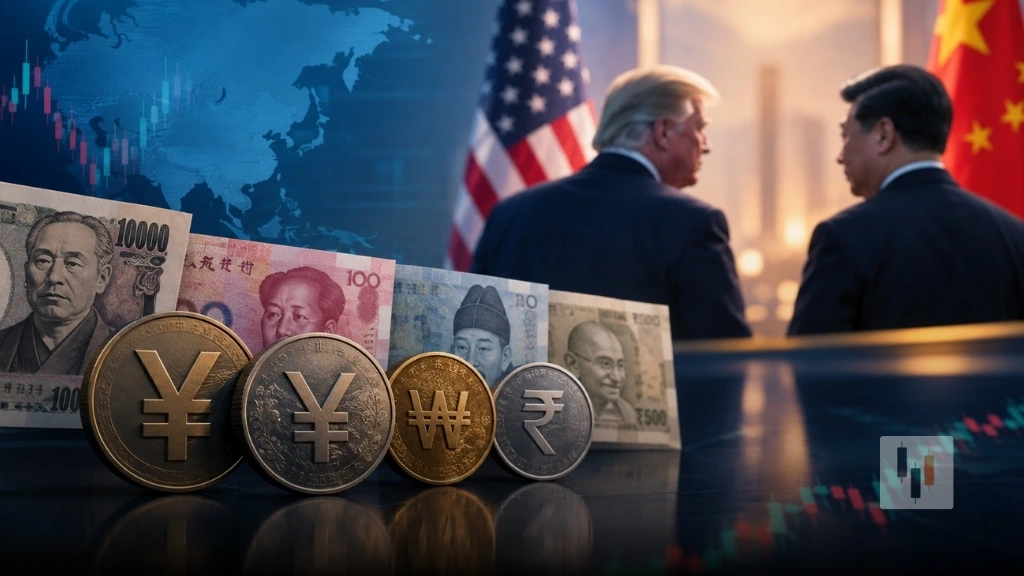
Most Asian currencies moved in a narrow range on Monday as investors monitored developments ahead of a planned meeting between U.S. President Donald Trump and Chinese President Xi Jinping in Washington later this week. The dollar edged higher, with the dollar index and its futures each rising 0.1%, extending gains after the greenback rose more than 1% last week. Trading was limited in parts of the region because of public holidays, with Japanese markets closed on Monday and Chinese and South Korean markets also due to close later in the week. The Japanese yen was little changed around 157 per dollar, while the Indian rupee and South Korean won each gained about 0.16% against the dollar. The Australian and Singapore dollars were broadly steady.
Why The Dollar Index Firmed Ahead Of The Trump-Xi Summit
The dollar’s modest rise came as attention shifted toward the Trump-Xi meeting, where trade and artificial intelligence are expected to be among the main subjects. The two leaders are scheduled to meet in Washington on Thursday, following discussions between senior U.S. and Chinese officials aimed at preparing the agenda. Investing.com reported that the dollar index and dollar index futures each rose 0.1% on Monday, while the broader Asian currency market remained relatively subdued.
What Bessent And He Lifeng Agreed On AI And Trade In New York
U.S. Treasury Secretary Scott Bessent and Chinese Vice Premier He Lifeng held talks in New York on Sunday covering trade and AI. According to Associated Press reporting, the United States proposed a new notification mechanism for artificial intelligence incidents that could affect national security. Bessent said the mechanism would provide a way for the two countries to communicate about potential AI-related risks.
The two sides also agreed to operationalize a new “Board of Trade,” first discussed when Trump and Xi met in Beijing in May, while U.S. Trade Representative Jamieson Greer said the countries were still discussing which nonsensitive products could potentially receive lower tariffs. The goods under discussion could include Chinese consumer products and U.S. energy, agricultural goods and medical devices. No final tariff changes for those categories were announced.
The existing U.S.-China trade truce is also due to expire in early November. The future of that arrangement is expected to be among the issues discussed when Trump and Xi meet. That the weekend talks were intended to prepare the ground for Thursday’s meeting. The market response to the upcoming summit remained limited. The Japanese yen hovered close to 157 per dollar after the Bank of Japan raised its policy rate by 25 basis points on Friday. The move had been widely expected, while the BOJ stopped short of signaling the timing of another increase. Other Asian currencies also recorded relatively small moves. The South Korean won strengthened 0.16%, while the Indian rupee gained 0.16%. The Australian dollar was flat, and the Singapore dollar also moved little.
Why The Yuan Hit A 3.5-Year High As The PBOC Eased Its Grip
China’s yuan touched a multi-year high on Monday after the People’s Bank of China set its strongest midpoint since February 2023. The one-year loan prime rate remained at 3.0%, while the five-year rate stayed at 3.50%, with both rates unchanged as expected. The yuan subsequently reached a fresh multi-year high. Reuters reported that the currency touched 6.6950 per dollar, its strongest since January 16, 2023, and closed at 6.6955, its strongest close since June 30, 2022. The offshore yuan was trading at 6.6946 per dollar, up about 0.03% in Asian trading. The PBOC set its daily midpoint at 6.7487 per dollar, the strongest since February 3, 2023, though still 536 pips weaker than a Reuters estimate. The midpoint is used as the reference rate for the yuan’s daily trading band, with the currency allowed to move within 2% on either side of that level.
Reuters reported that the PBOC has recently allowed the official midpoint to strengthen at a faster pace, reducing the gap between the central bank’s guidance and market expectations. The report said this has been interpreted by traders and analysts as a sign that the central bank has eased its efforts to slow the yuan’s appreciation. The yuan’s move came as the broader currency market remained relatively stable. Reuters reported that the dollar index was steady at 100.23 after gaining more than 1% last week.
For Asian currency markets, attention now remains on the Trump-Xi meeting and any new information on trade, tariffs and AI discussions. The limited moves across several regional currencies also reflect reduced trading activity because of holidays in major Asian markets. The outcome of the summit and subsequent policy discussions could provide further direction for currencies later in the week.