

Key Highlights
- Bob Michele of J.P. Morgan Asset Management highlights a “generational amount of yield,” marking real US yields (3%) at levels not seen since 2002.
- Yield payouts plus capital gains could boost US bond returns to 7%–8% over the next year.
- Market yields and the benchmark Fed funds rate are projected to flatten around 4.5% as the central bank concludes its current tightening cycle.
Bob Michele, global fixed income head at J.P. Morgan Asset Management, has said that the bond market offers a very attractive entry point for investors, Reuters reported. Speaking to reporters in Singapore, Michele highlighted that fixed income markets offer a “generational amount of yield,” creating a prime environment to accumulate debt. High yields and potential price growth could push US fixed income returns to 7%–8% over the next year
The remarks come after debt markets recently rebounded from a significant selloff that took a toll on developed-market sovereign bonds. Michele pointed out that a major buy signal occurred when real yields in the United States fell to 3%, which coincided with the nominal 10-year US Treasury yield spiking over 5%. “The last time we saw that was 2002. So at close to 25 years, that’s a buying opportunity,” he observed.
A Rare Entry Point for Fixed Income
Global sovereign debt desks have recently experienced price changes that have realigned risk to reward. The reallocation of capital in fixed income has resulted in massive repricing, making those assets much more affordable. This change has raised entrance yields across the board, creating a defensive margin of safety.
The mechanism fueling this performance rests on cash flow accumulation and expanding valuations. Fixed income securities offer significant cash flows as nominal yields reached a historic high before leveling off. Such baseline payments safeguard capital portfolios from erosion and still allow them to be exposed to capital gains if macroeconomic conditions make yields back up. Returns are driven by steady cash flow and expanding valuations.
Yield Curves and the End of Tightening
Monetary policy is a key component in this market view. Yields are expected to reprice as the rate-hike cycle ends. “We expect both the Fed funds rate and the Treasury curve to converge (around 4.5%),” Michele explained. He noted that interest rates and government bond yields typically flatten at the end of a hiking cycle, stating, “Generally, at the end of a hiking cycle the yield curve is flat … so there’s plenty of room for yields to run from where they are.”
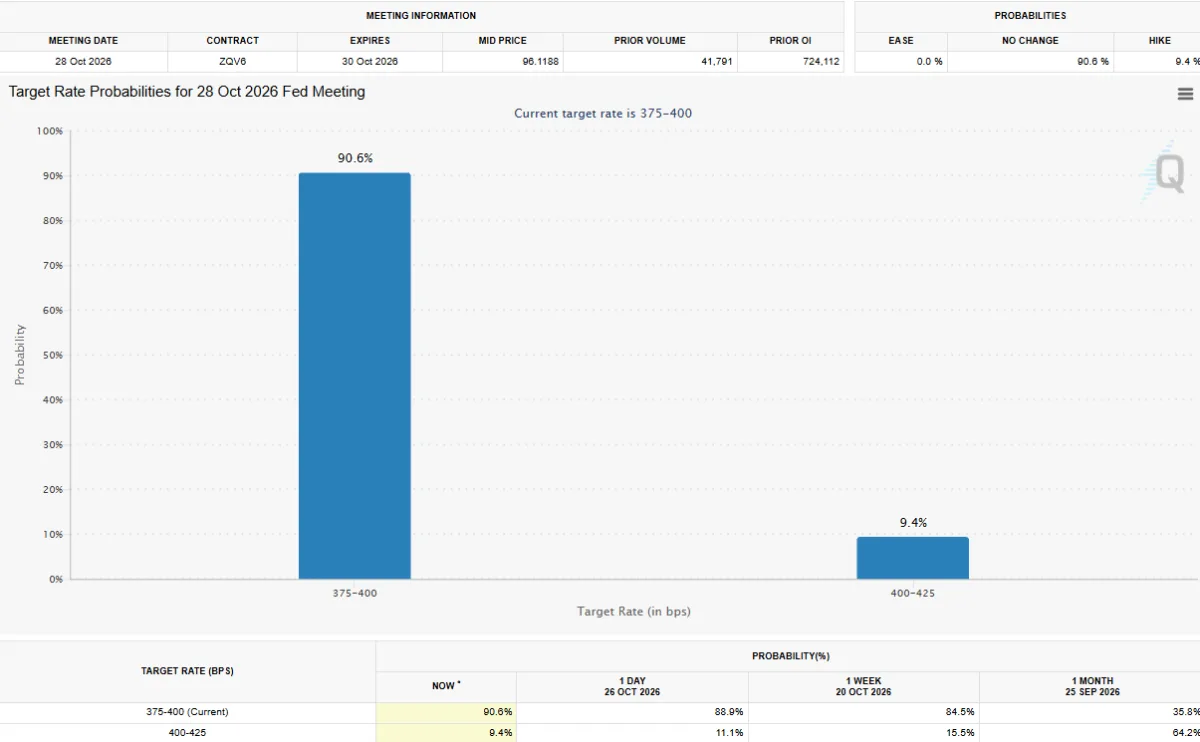
This backdrop sets the stage for the Fed’s next meeting. Market participants expect the Fed to keep the Fed funds rate window at 3.75% to 4%.
Global Allocations and Macro Resilience
The overall economic environment is favorable to debt. Global capital expenditures are high, which reduces the risk of a large drop in economic activity. According to Michele, “It’s pretty clear with the global capex cycle out there, recession is a very low probability. That means every backup in credit spread (you) should buy.” There are still appealing prospects abroad, such as in Japan, Australia, investment-grade corporate credits, and emerging-market sovereign bonds.
Inflation and Policy Over-Tightening Risks
The key threat, however, is that inflation remains higher than expected, necessitating a more aggressive policy tightening by central banks. The main “tail risk,” Michele cautioned, was the Federal Reserve needing to push interest rates significantly higher than the projected 4.5% target to successfully bring down persistent price pressures. Without that aggressive policy extension, the environment remains heavily skewed toward fixed income accumulation, supported by the reality that “there is yield all over the place.